Encrypting Files for Long-Term Storage: A Researcher's Guide to Quantum-Resistant Archival
Data archived for decades must survive the quantum era. AES-256-GCM encryption ensures long-term stored data remains unreadable to future quantum computers.
The Long-Term Data Problem
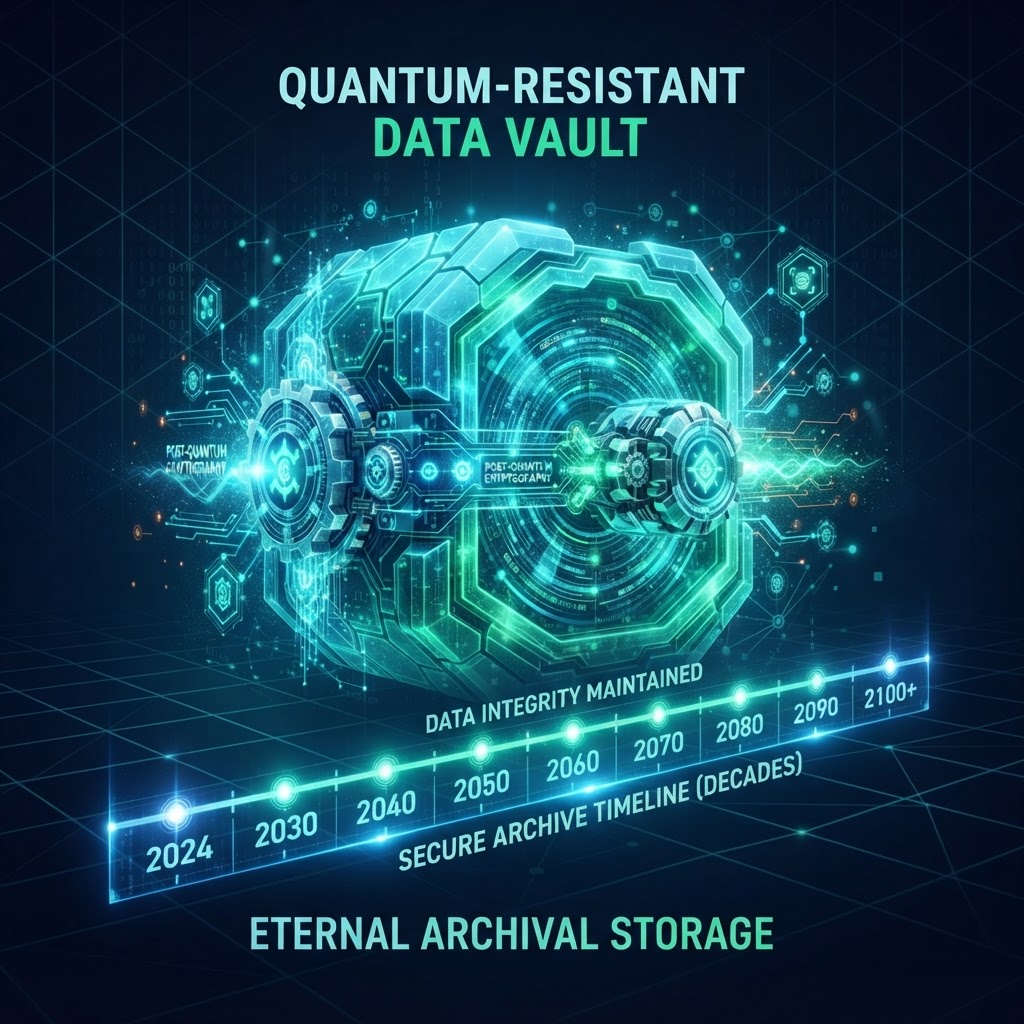
Not all data is ephemeral. Some data must be preserved for decades, or even indefinitely. Genomic data, classified government records, intellectual property, medical histories, and legal evidence all have retention requirements that span 20 to 100 years. This data will still exist when quantum computers mature, and if it is not encrypted with quantum-resistant algorithms, it will be readable by anyone who obtains it.
The challenge of archival encryption is different from the challenge of communication encryption. Communications are ephemeral: once the session ends, the encrypted traffic is no longer relevant. But archived data sits in storage, waiting. An attacker can harvest it today and decrypt it whenever the technology catches up, whether that is in 5 years or 50.
Why Most Archival Encryption Is Inadequate
Many organizations encrypt archival data with AES-128, believing it provides sufficient security. Against classical computers, it does. Against quantum computers, it does not. Grover's algorithm reduces AES-128's effective security to 64 bits, which is within the reach of a sufficiently powerful quantum computer. A 64-bit key space is approximately 1.8 x 10^19 operations, a figure that a large-scale quantum computer could theoretically exhaust.
AES-256, by contrast, retains 128 bits of post-quantum security. The difference between 64-bit and 128-bit security is not a factor of two. It is a factor of 2^64, approximately 1.8 x 10^19. In other words, upgrading from AES-128 to AES-256 does not double your quantum security. It multiplies it by 18 quintillion.
The Key Derivation Factor
For archival encryption, key derivation is as important as the cipher itself. If the passphrase is weak, the attacker can brute-force the passphrase rather than the key. This is where PBKDF2 iteration count matters.
CryptShield uses PBKDF2 with hundreds of thousands of iterations. Each iteration applies a hash function to the passphrase and salt, and the output of one iteration becomes the input of the next. This means that each passphrase guess requires hundreds of thousands of hash operations, not one. An attacker attempting to brute-force a passphrase must repeat this entire process for every guess.
For archival data, where the attacker may have decades to work, this computational cost is the difference between a feasible attack and an impossible one. A passphrase that would fall to a single-hash brute-force attack in weeks may require centuries when each guess costs hundreds of thousands of iterations.
Practical Recommendations for Archival Encryption
- Use AES-256-GCM, not AES-128. The post-quantum security difference is not incremental; it is astronomical.
- Use a strong passphrase. A random passphrase of 12 or more characters provides sufficient entropy even against quantum-accelerated brute-force.
- Use high-iteration PBKDF2. Hundreds of thousands of iterations make each guess computationally expensive.
- Store the encrypted file, not the passphrase. The passphrase should exist only in memory or in a separate, physically secured location.
- Encrypt before archiving. The data should be encrypted on the user's device before it reaches any storage system.
Key Takeaways
- Archival data with long retention periods will be exposed to mature quantum computers, making quantum-resistant encryption essential.
- AES-128's post-quantum security is only 64 bits; AES-256 retains 128 bits, a difference of 2^64.
- High-iteration PBKDF2 key derivation makes passphrase brute-force computationally infeasible even with quantum acceleration.
- CryptShield encrypts archival data with AES-256-GCM and high-iteration PBKDF2, designed for decades of quantum-safe storage.
Protect your data with quantum-resistant encryption
Encrypt files and text in your browser with AES-256-GCM — zero servers, zero knowledge.
Try CryptShield Now